Nov 6, 2026
Faceless YouTube Channel: How to Start in 2026
A faceless YouTube channel can earn if it adds real value. Learn what one is, which formats and ideas work, how to stay anonymous, and how to start in 2026.

A faceless YouTube channel is a channel where the creator never appears on camera, and narration, footage, animation or screen recordings carry each video instead. It can earn money the same way any other channel does, and YouTube has no rule against it. What it can't do is run on repetitive, low-effort videos, because those are what YouTube refuses to pay for.
This guide covers the main formats, channel ideas, the steps to get started, how much anonymity you really get, and what keeps people watching when nobody is on screen.
What is a faceless YouTube channel?
A faceless YouTube channel, also written as a YouTube faceless channel, publishes videos without showing the person who makes them. The voice can be yours, a hired narrator's or an AI voice. The pictures can be stock footage, animation, screen recordings, gameplay or a pair of hands. Whichever way people search for youtube faceless content, they mean the same thing: the video is the star, not a host.
Faceless is a production choice, not a business model. It often gets mixed up with YouTube automation, which means handing work to freelancers, software or AI. You can make a faceless channel entirely by hand, and you can outsource a channel that has a presenter.
Three things draw people to it:
- Privacy. You can publish without tying the channel to your face.
- A low barrier. Most formats need no camera, lights or set, just a quiet room and a laptop.
- A repeatable shape. Once the structure and look are fixed, each new episode is easier to plan.
The trade-off is trust. A presenter earns attention just by being there. Without one, the script, the voice and the pictures have to do that job, so the format you choose matters more than it does on a personal channel.
Do faceless YouTube channels still work in 2026?
Yes, faceless YouTube channels still work in 2026, but the lazy version doesn't. YouTube's channel monetization policies never mention showing your face. They ask whether a channel's videos are original and authentic.
In July 2025, YouTube renamed its repetitious content policy to inauthentic content. Its examples include image slideshows and scrolling text with "minimal or no narrative, commentary, or educational value", along with AI videos built from generic templates. A separate reused content policy covers channels that repurpose other people's material, including videos that only read out text you didn't write.
So a narrated documentary built on licensed footage is fine, while a hundred near-identical slideshows are not. The line runs through the effort in each video, not through whether you appear in it. A quick test: if a viewer couldn't tell your last five videos apart, the channel has a problem no voice or thumbnail will fix.
The rules for earning are also the same as for everyone else. To share in ad revenue you need to join the YouTube Partner Program, which takes 1,000 subscribers plus 4,000 qualified watch hours in 12 months, or 10 million qualified Shorts views in 90 days, followed by a channel review. Our YouTube automation guide works through what reviewers check, and how to calculate your break-even views.
Six formats, and how to choose one
Pick the format before the niche. It decides how long each video takes, which skills you need and how easily someone else can copy you.

| Format | What holds attention | Effort per video | Main risk |
|---|---|---|---|
| Voiceover with stock footage | The script and narration | Low to medium | Looks generic without a point of view |
| Animation or motion graphics | A visual style of your own | High | Slow to produce |
| Screen recording | A useful demonstration | Low | Tutorials date quickly |
| Hands-only demonstration | The process itself | Medium | Needs real skill and a tidy setup |
| Gameplay with commentary | The personality in the voice | Medium | A crowded space |
| Ambient music or sound | Mood | Low once set up | Rights to every track, and repetition |
To choose, answer three questions honestly. Could you make ten of these without losing interest? What could you add that the top videos in this format don't have? Which stage would you enjoy doing yourself, and which would you hand to a tool? A format you can sustain for a year beats a better-paying one you drop in a month.
Faceless YouTube channel ideas by format
The top faceless YouTube niches share one trait: viewers care about the information or the story more than who delivers it. These faceless YouTube channel ideas are starting points, and each one gets stronger when you narrow it to a specific audience.
| Format | Ideas to adapt |
|---|---|
| Voiceover with stock footage | Forgotten history, how everyday things are made, business case studies, unsolved mysteries |
| Animation or motion graphics | Science explainers, money concepts for beginners, geography comparisons |
| Screen recording | Software walkthroughs for one profession, spreadsheet techniques |
| Hands-only demonstration | Restoring old tools, one regional cuisine |
| Ambient music or sound | Study soundscapes, rain and city sounds for sleep |
The easiest to run is usually voiceover with stock footage, on a subject you already understand. Finance and health draw strong interest, but advertiser demand varies by topic, and mistakes in these areas can hurt real people, so only choose them if you can check every claim.
To test an idea, write 30 video titles for it before you make anything. If you run dry at 12, the niche is too narrow or you aren't interested enough. Then search YouTube for your best ten. Small channels whose videos beat their subscriber count are a good sign that people want the topic and nobody owns it yet.
How to start a faceless YouTube channel
Starting a faceless YouTube channel comes down to seven steps. The order matters, because you want to prove one format before you publish at volume.
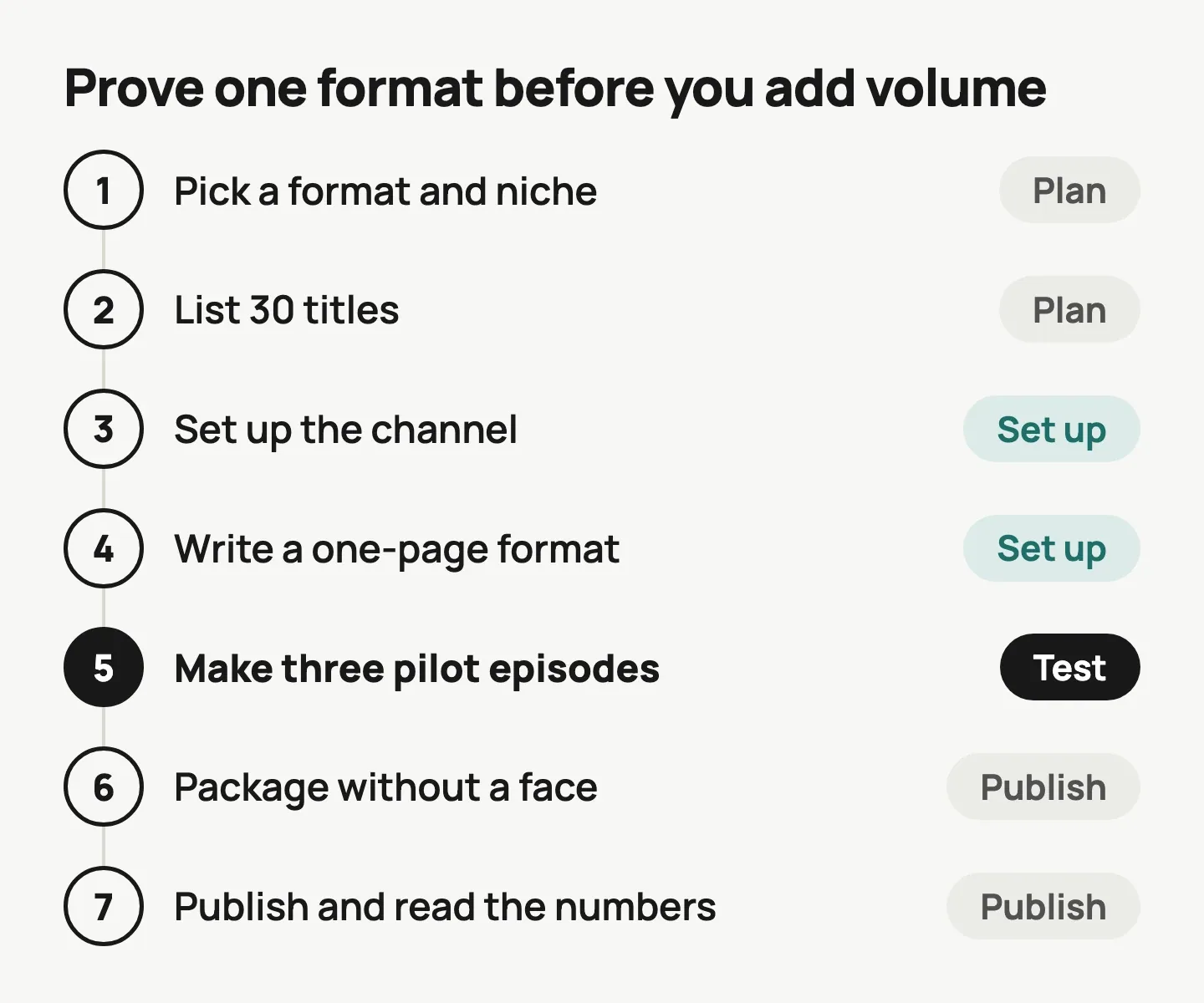
Step 1: Pick one format and one niche
Use the table above and commit to a single combination. Faceless channels that mix unrelated topics are hard to recommend and hard to review, so keep the first 20 videos on one subject.
Step 2: List 30 titles
Your title list doubles as your content plan. Sort it by what you could make first, and mark the ideas that need research you can't do yet.
Step 3: Set up the channel
Create the account, name and handle now, not after your first upload, because they are hard to untangle later. The section on anonymity below covers exactly how.
Step 4: Write a one-page format
Note the video length, how each one opens, the structure, the tone, the caption style and your rules for pictures. This page is what makes separate videos feel like one show. It also gives a freelancer or an AI tool something concrete to follow.
Step 5: Make three pilot episodes
Make three videos on different topics using the same rules. Time each stage and write down everything you had to fix. Then watch all three in a row. If they feel repetitive to you, they will feel worse to a stranger.
Step 6: Package without a face
A face is the easy way to stop a scroll, so your thumbnail needs another hook: one strong object, high contrast and very few words. Promise only what the video delivers. You can upload your own cover or generate a background in a style you like.
Step 7: Publish and read the numbers
Choose a schedule you can hold for months. After each batch, read click-through rate and audience retention. Low clicks point to packaging, an early drop points to the opening, and a late drop points to the structure.
How to stay anonymous
Faceless doesn't mean anonymous. Hiding your face removes only one of the things that can identify you, so treat the channel as a separate identity from the first day.
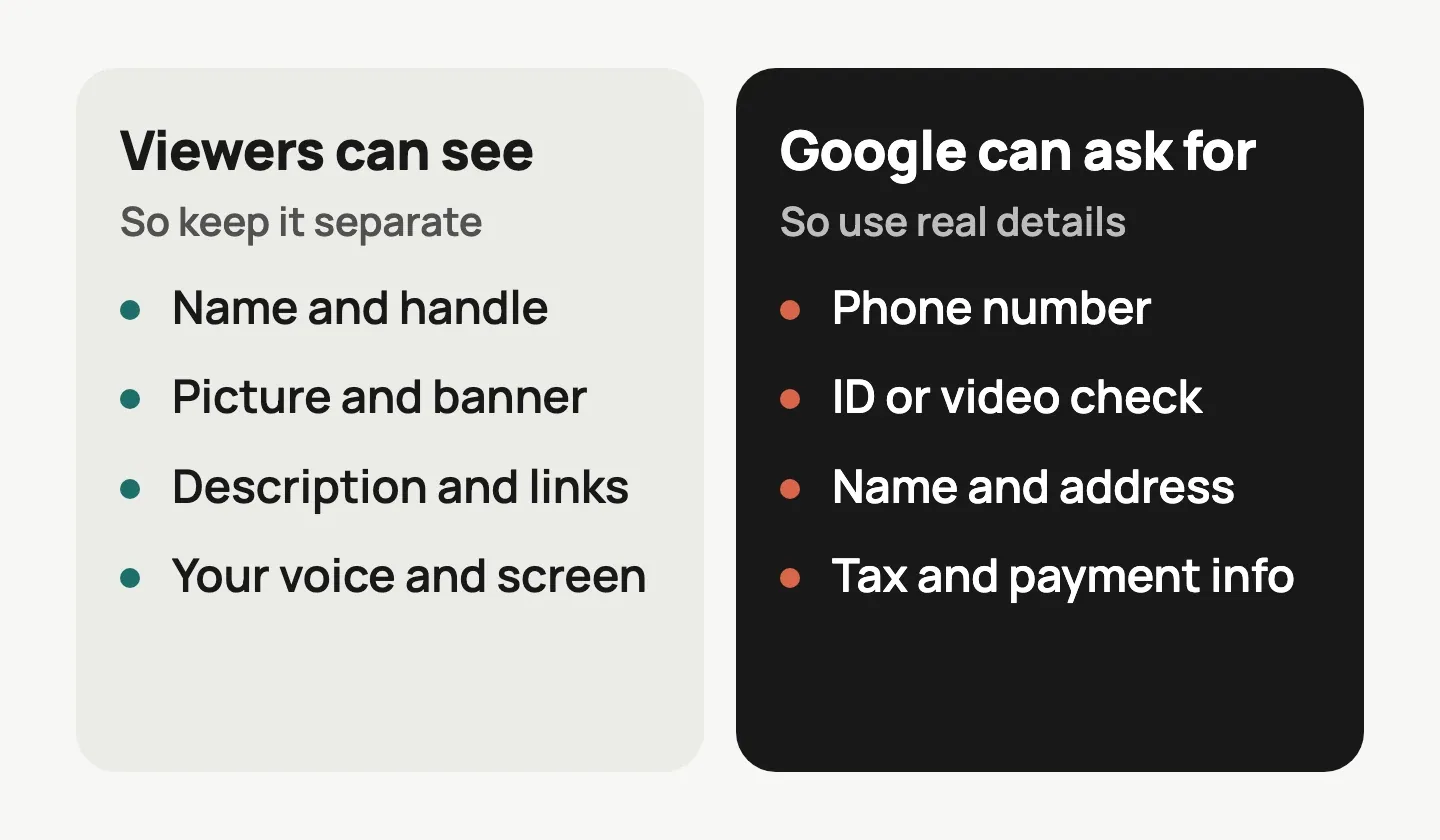
Six habits cover most of the risk:
- Use a separate Google Account. Give the channel its own email, so nothing links it to your personal inbox.
- Consider a Brand Account. YouTube lets you connect a channel to a Brand Account to use a different name from your Google Account, and to add other managers.
- Choose a new name and handle. Reused usernames are the easiest way to connect two accounts.
- Keep the public page clean. Use a channel-only contact email and leave personal links out of the description.
- Check every frame. Screen recordings can reveal browser tabs, bookmarks, notifications and file names.
- Think about your voice. People who know you can recognize it. A hired or AI voice avoids that.
Being anonymous to viewers isn't the same as being anonymous to Google. Phone verification unlocks features such as longer videos and custom thumbnails. Applying for monetization is an advanced feature, which needs channel history or, where it's offered, ID or video verification. To get paid, AdSense for YouTube asks for your personal, tax and payment details, and Google verifies your identity and address once earnings reach a threshold. Use your real details there, and keep them out of everything viewers can see.
How to keep viewers without a face on screen
Without a host, watch time depends on craft. Four things do most of the work.
An opening that starts the story
Begin with the question or the promise, not a greeting or a logo. The first sentences should tell viewers exactly what they will get for staying.
A picture for every line
Each line of the script should show what it says, and the picture should change when the idea changes. Loosely related stock shots are the fastest way to look cheap, so replace any shot you can't justify.
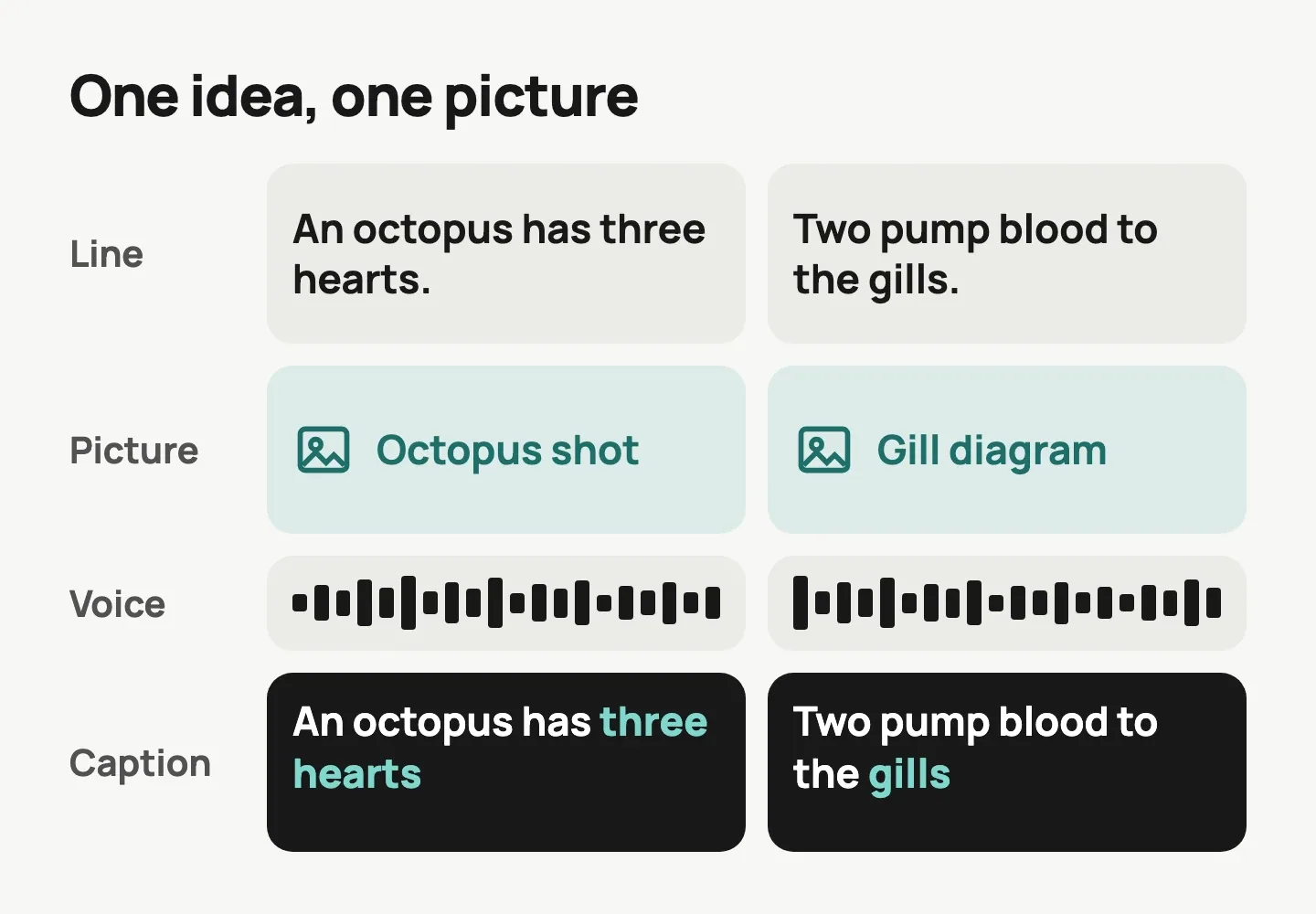
A voice that sounds like a person
Write for the ear: short sentences, one idea each, and words you would actually say. Read the script aloud before you record it. Whether the voice is yours or AI, listen to the whole take and fix any name it gets wrong.
Captions and sound that stay out of the way
Captions keep people following along on a phone with the sound low, so make sure they match the words exactly. Keep music well under the voice, and leave a moment of quiet when a point needs to land.
How to make a faceless YouTube channel with AI
AI can do most of the production on a faceless AI YouTube channel, but it can't supply the judgment. Do faceless AI YouTube channels work? They do when a person picks the angle, checks the facts and fixes what the tool gets wrong. They fail when the tool runs unchecked.
Here is how that looks in Go Motion, a browser studio for narrated faceless videos:
- Start from an idea or a finished script. If you paste a script, your wording is kept and only split into scenes.
- Review every scene before you pay for production.
- Go Motion produces the narration, word-timed captions and matched footage together.
- Fix what misses, scene by scene: rewrite a line, swap a picture from stock and archive libraries, or upload your own.
- Export a 1080p MP4 with SRT and VTT captions, then upload it in YouTube Studio with your title, description and thumbnail.
A minute of video costs 45 credits from idea to MP4, which puts an eight-minute episode at about $20 on the Starter pack. See the pricing page for current plans.
Two rules apply whichever tool you use. Confirm you have the right to use every clip, track and voice. And check YouTube's AI disclosure rules, which cover realistic altered or synthetic content, not AI help with a script or title.
Common mistakes to avoid
- Choosing a niche by ad rates alone. You will quit before the numbers matter.
- Copying a successful channel. Swapping the nouns in someone else's format gives viewers no reason to switch, and it's exactly what the rules target.
- Publishing 30 videos before reading one. Volume multiplies a weak format.
- Using clips you can't explain. Reused footage needs real commentary or change, and the right to use it.
- Leaving privacy for later. A personal email or old username is hard to remove after the channel grows.
Frequently asked questions
Can a faceless YouTube channel make money?
Yes. A faceless YouTube channel earns the same ways as any other: ads through the Partner Program, sponsorships, affiliate links, memberships and digital products. YouTube doesn't pay less because nobody is on camera. Income depends on views, audience and topic, so anyone promising a specific figure is guessing or selling something.
Are faceless YouTube channels still profitable?
They can be, but profit isn't automatic. Costs are low compared with a filmed show, yet ad income only starts after you join the Partner Program, which can take months or years. Channels that last usually have a distinct format and a topic their owner knows well. Run your own numbers before you scale up.
Is YouTube suppressing faceless channels?
YouTube's published policies don't single out faceless channels. What YouTube limits is mass-produced, repetitive content, and many faceless channels happen to look like that. If your views have dropped, check click-through rate and retention first, then ask honestly whether your last five videos look interchangeable to a new viewer.
Does YouTube monetize faceless AI voice channels?
It can. YouTube's monetization policies don't ban AI voices, and they judge the channel as a whole. An AI voice reading a generic script over random clips is at risk, while the same voice narrating original research is not. Choose a natural voice, because listeners leave quickly when narration grates on them.
How much does it cost to start a faceless YouTube channel?
Opening a channel is free, so production is the real cost, along with your time and any licensed music. In Go Motion, an eight-minute episode takes 360 credits, which is about $20 on the Starter pack or about $7 on the Pro pack. New accounts start with free credits for a first test.
How many views do you need to make $10,000 a month?
It depends on your RPM, which is what you earn per 1,000 views. Divide 10,000 by your RPM, then multiply by 1,000. At an example RPM of $3, that is about 3.3 million views a month. RPM varies by topic, audience and season, so use your real figure from YouTube Studio.
Who is the most famous faceless YouTuber?
No official ranking exists, but Kurzgesagt, Lofi Girl and Mr. Nightmare are among the best-known faceless channels. Kurzgesagt explains science through animation, Lofi Girl streams music behind an illustrated character, and Mr. Nightmare narrates scary stories. Each built a recognizable identity without a presenter, and that identity is the lesson worth taking.
Start your faceless YouTube channel with one video
You don't need a finished plan to begin. Pick a format, list 30 titles and make one episode you would watch to the end. That single video will teach you more than another week of research.
Start your faceless YouTube channel with Go Motion: bring an idea or a script, review the scenes, and export a finished video. New accounts start with free credits, and every paid step shows its price before it runs.